
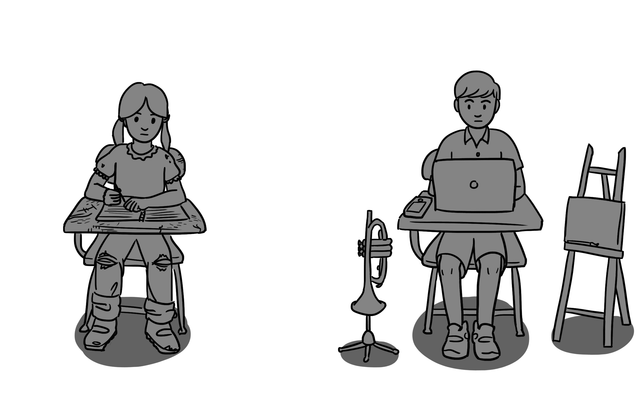
Many of us grew up participating in extracurricular activities! They had a meaningful impact on our
development, they made us responsible, and for many of us, it was a way to find our passions. But this is
not a universal experience because many children can’t afford to participate in extracurricular activities.
Underprivileged kids then find themselves at a greater disadvantage because they lack the experience needed
for college applications, meaning their options remain limited.
The extracurricular gap is the gap between students with higher-income parents who have access to more
extracurriculars than those with lower-income parents. Consequently, those with access to more activities
often have better opportunities throughout their life. An article published by SAGE
Journal says that
“Participation in extracurricular activities is associated with positive youth outcomes such as higher
education attainment and greater future earnings.” Upper-middle-class students have parents who can afford
these activities and all the expenses associated with them.
Income is a high determining factor in our access to opportunities in most cases. Think about it– in the US
a typical parent spends $693 per year on each child’s extracurriculars. This amount may reach $12,000 for
children enrolled in elite programs like lacrosse, tennis, or ice hockey which require expensive equipment,
uniforms, and specialized coaches.
Okay, but what about volunteering? Volunteering can be more accessible but it still contributes to the gap.
Depending on where you live, there may not be enough volunteering opportunities available, or your parents’
schedules may not be flexible enough, making them ultimately inaccessible.
Moreover, an article by The Atlantic "
showed that a lack of extracurriculars increases children’s exposure to hardships associated with low-income
status, such as violence or unstable households.
Upper-middle-class students end up with more extracurriculars on their CVs as a result of this gap, meaning
they have stronger profiles for applications to university, internships, and scholarships. Furthermore, they
develop soft skills that prepare them for careers. They are also exposed to positive role models who inspire
them set goals.
Extracurriculars play a very important role in admissions. Two kids may have the same scores, but the one
that has more extracurriculars is more likely to get accepted because extracurriculars allow one to
demonstrate the qualities of a well-rounded person. Although this makes sense, these standards oftentimes
perpetuate socio-economic inequality. Yet, this is not a problem with the university evaluation system but
rather with the system itself that creates this extracurricular gap.
The article by The Atlantic "
shows that this is a funding issue. State budget cuts force certain districts to reduce spending, and the
first costs cut are for extracurricular activities. This means parents are required to pay amounts that make
the difference between a kid joining a club or not. Therefore, it is extremely important to develop programs
that help students finance their extracurricular activities or support existing ones, like
ámaxa ", since it is such a crucial part of their personal development.
This is particularly important given that, in the US, the largest poverty rates are among African Americans
and Hispanics, two minority who also encounter discrimination. Providing accessible opportunities for those
students means diverse groups can become more actively engaged in the political, economic, and social
aspects of society.
At ámaxa, we focus on finding ways to help our students create a meaningful and tangible impact locally or
abroad by collaborating with amazing nonprofits that have a great track record.
Check out our blog to find amazing local and remote
opportunities, or join our Student Impact
Program and start solving problems with global non-profits!